// Guide
Suspension service intervals — why your forks fade before they fail
Suspension doesn't break. It fades — slowly enough that you adjust your riding and never notice. Here's the service clock for forks, shock and linkage, and how to read what your bike is telling you.
Updated 15 May 2026
Suspension doesn’t fail the way a chain or a piston fails. There’s rarely a moment. It fades — the oil shears down a little every ride, the seals weep, the nitrogen bleeds off — and because it happens slowly, you adjust. You stand up earlier, you brake softer, you tell yourself the track is rougher than last month.
Then you ride a mate’s freshly serviced bike and realise how far yours has drifted.
This is the service clock for forks, shock and linkage, how to set and read sag, and how to tell tired suspension from suspension that’s just set up wrong.
Why suspension fades slowly
Three things age inside your suspension, and none of them announce themselves.
The oil shears. Fork and shock oil is worked hard — forced through tiny valve ports thousands of times a ride, heated, sheared. Over hours it loses viscosity. Thinner oil flows through the valving faster, so damping drops off. The fork feels less controlled, dives more on the brakes, blows through the stroke on big hits.
The seals weep. Long before a seal blows and dumps oil down the leg, it’s passing a film. Oil level drops slowly, air volume changes, and the fork’s air spring — which does real work in the back half of the stroke — shifts under you.
The nitrogen bleeds. A shock’s nitrogen charge keeps the oil under pressure so it doesn’t cavitate. That charge drops over months whether you ride or not. A soft charge lets the oil foam, and a foaming shock fades badly as it heats through a moto.
None of it is dramatic. That’s the whole problem. Service intervals exist because you cannot feel this happening — by the time you can, you’ve been riding compromised suspension for a long time.
Reading your sag
Sag is the first thing to check and the cheapest. It needs a tape measure and a mate.
Race sag (also called rider sag) is how far the bike settles with you on it, in full kit, feet on the pegs. Measure rear-axle-to-a-fixed-point fully extended, then with you aboard. The difference is your race sag.
- MX: roughly 100–105 mm at the rear.
- Enduro: roughly 105–110 mm — slightly more for traction and comfort.
Set race sag with the shock spring preload collars.
Static sag (or free sag) is how far the bike settles under its own weight, no rider. Once race sag is set, measure static sag. It should land around 30–40 mm.
Static sag is the tell. If race sag is correct but static sag is too little (under ~25 mm), your spring is too soft — you’ve wound in heavy preload to fake the right race sag. If static sag is too much (over ~45 mm), the spring is too stiff for you. Either way, no clicker setting fixes a wrong spring (see below).
Check sag at the start of every season and any time the bike feels off. It moves — springs settle, and your kit weight changes between summer and winter.
The fork service interval
Fork oil is a wear item with no warning light. Go by hours.
| Riding style | Fork oil + seal service |
|---|---|
| MX racing | every 15–25 hours |
| MX practice / training | every 25–40 hours |
| Enduro / hard enduro | every 20–40 hours — sand and water shorten it |
| Trail / green-laning | every 40–60 hours |
| Casual / play | annually, regardless of hours |
These are oil-and-seal intervals — fresh oil, new seals and dust seals, bushes inspected. A full revalve or respring is a separate, much longer interval driven by setup, not wear.
Two things move the numbers. Heat — a fork worked hard on a rough MX track ages oil faster than the hours alone suggest. Grit — every time the dust seal lets fine dirt past, it scores the stanchion and accelerates seal wear. Clean and grease your dust seals every few rides; it’s the single cheapest way to stretch a fork service.
If you ride sand or wet enduro, treat the short end of every range as the target.
The shock works harder
Riders service the fork and forget the shock. The shock is the part that needs it more.
A shock holds far less oil than a pair of fork legs, works that smaller volume just as hard, and has nowhere near the surface area to shed heat. It runs hotter, so its oil shears down faster. On top of that the nitrogen charge bleeds off over time — and a shock low on nitrogen lets its oil cavitate and foam, which kills damping mid-moto exactly when you’re tired and need the bike calm.
The rule: service the shock at least as often as the fork. If your forks are on a 20-hour clock, don’t leave the shock at 50. Many race setups do the shock more often than the fork, not less.
A shock service is oil, seal head, and a fresh nitrogen charge. The nitrogen alone means it’s not usually a home job — see the last section.
Signs your suspension is tired
Hours are the proper guide, but the bike does tell you. Watch for:
- Harsh, busy front end. Small bumps come through sharp, the bike deflects off roots and braking ruts. Tired oil and worn bushes.
- Packing. On repeated hits — braking bumps, a rough downhill — the suspension doesn’t recover between bumps and rides lower and lower through the section. Worn oil, or rebound damping that’s faded off.
- Blowing through the stroke. The fork or shock uses all its travel on hits that shouldn’t need it, with a hard clonk at the end. Lost compression damping.
- An oil film on the stanchions or shock body. Weeping seal. Not urgent the day you spot it, but the service clock just sped up.
- A clunk over square edges. Often not the damper at all — worn linkage or swingarm bearings (next section).
- The bike won’t hold a setting. You set clickers, it feels right, two rides later it doesn’t. The oil is moving around under you.
One tired symptom on a bike that’s well within its hours is worth a clicker check first. Several symptoms together, or any of them on a bike you can’t date — book the service.
Linkage and pivot bearings
The forgotten service. Your shock doesn’t bolt straight to the swingarm — it works through a linkage, and that linkage runs on needle bearings that need grease and, eventually, replacement.
Run them dry and the bearings seize or rust, the rear suspension gets notchy and stiff through its mid-stroke, and you get that clunk over square edges that everyone blames on the shock. Left long enough, a seized linkage bearing wears the pin and the bore — a cheap bearing kit becomes an expensive one.
Service intervals:
- Strip, clean and re-grease linkage and swingarm pivot bearings at least once a year, or every 40–60 hours.
- Pressure-washer riders, and anyone in sand or deep water — every 20–30 hours. A pressure washer drives water straight past those seals.
- Replace the bearings when they feel rough, notchy or pitted, or when the pins show wear.
It’s an hour with hand tools, a grease gun and a bearing kit. Do it with a fork service and you’ve covered the whole rear end in one afternoon.
Spring rate is not a service job
This catches people out. No amount of fresh oil or clicker adjustment fixes a spring that’s wrong for your weight.
Stock springs — fork and shock — are picked for an average rider, usually somewhere around 75 kg in kit. If you’re well outside that, the bike was never set up for you. A heavier rider on soft stock springs rides deep in the stroke, blows through travel, and runs out of preload trying to set sag. A lighter rider on stiff springs gets a harsh bike that never uses its travel.
The sag check above is how you find this. Correct race sag and correct static sag means the springs roughly suit you. If you can only get one of the two right, the spring rate is wrong — and that’s a parts decision, not a service.
Spring rate is matched to rider weight (in full kit) against a manufacturer’s chart. Fork and shock should be changed as a pair so the bike stays balanced. Get the rate right once and every service after that is just maintenance.
DIY or the suspension shop
Honest split of what’s worth doing at home.
Do at home:
- Sag and clickers. Tape measure, a mate, the manual. No excuse not to.
- Dust seal cleaning and greasing. A few minutes every few rides. Biggest return for the effort on this whole list.
- Linkage and pivot grease. Hand tools and a grease gun. Straightforward.
- Fork oil and seal change. Doable if you’re handy and patient. You’ll want a seal driver, a way to hold the cartridge, and the correct oil to the correct air gap. Get the air gap wrong and the fork’s air spring is wrong — measure it properly.
Send out:
- Shock service. Needs a nitrogen charge and the right fixtures. A badly assembled shock can let go under load. Not a home job.
- Any revalve or respring. This is tuning, not maintenance — a suspension tuner sets it to your weight, pace and tracks.
A fork-and-shock oil service at a suspension shop runs roughly £120–£180 plus parts. For a bike you ride hard, money well spent — it comes back set up properly and on a clean service clock.
The right kit
What a suspension service actually consumes:
- Fork oil. Buy by viscosity in centistokes (cSt at 40°C), not by the “W” number — the W rating isn’t consistent between brands. Match the spec in your manual or from your tuner, and stay with one brand.
- Fork seal kits. One oil seal and one dust seal per leg — buy two. Seals are diameter-specific: 48 mm and 43 mm cover most modern MX bikes, with 49 mm common on KYB enduro forks. The size is marked on the stanchion or in the manual.
- Linkage bearing kits. Needle bearings, seals and sometimes pins, sold per bike. Replace when rough — don’t just re-grease a pitted bearing.
- Fork and shock springs. Rate-matched to your weight in kit. Change as a pair.
- Grease. A quality waterproof grease for linkage and seals. The cheap stuff washes straight out.
Everything here is fitment-specific — seal diameter, spring rate, oil spec all change between models. Filter by your bike and you’ll see only what fits, which beats cross-referencing part numbers at the bench.
// In stock now
Suspension parts in stock
Seals, oil, springs, linkage bearings. Fitment varies by bike — filter by yours to see what fits.
ATHENA
ATHENA FORK OIL SEAL KIT MGR-RS 43x52,7x9,5/10,3
£35.20
ATHENA
ATHENA FORK OIL SEAL KIT MGR-RSA 41x54x11
£8.45
ATHENA
ATHENA FORK OIL SEAL KIT MGR-RSA 35x48x11
£7.78
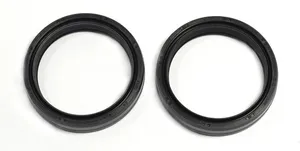
ATHENA
ATHENA FORK OIL SEAL KIT MGR-RSD 47x58x10
£5.82
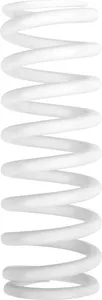
MOOSE OFFROAD HARD-PARTS
MOOSE OFFROAD HARD-PARTS SHOCK ABSORBER SPRING 40N WP WHITE
£80.82
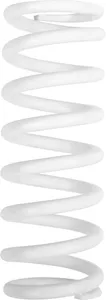
MOOSE OFFROAD HARD-PARTS
MOOSE OFFROAD HARD-PARTS SHOCK ABSORBER SPRING 45N WP WHITE
£80.74

MOOSE OFFROAD HARD-PARTS
MOOSE OFFROAD HARD-PARTS FF SPRING SET 29.5MM 2.4
£78.58
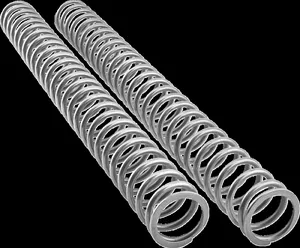
MOOSE OFFROAD HARD-PARTS
MOOSE OFFROAD HARD-PARTS FF SPRING SET 43.5MM 4.8
£78.35
// Find what fits your bike
Service parts, sized to your bike.
Seal diameters, spring rates and oil specs all change between models. Tell us the bike and we'll show you what fits — no cross-referencing.
24,868 parts · 55 brands
// FAQ
Frequently asked questions
How do I know my fork oil is due if nothing's leaking?
You mostly don't, by feel — that's the trap. Oil shears down gradually, so the fork gets harsher and less controlled over weeks and you adjust your riding to suit without noticing. Go by hours, not symptoms. If you genuinely can't remember the last oil change, it's due.
Can I just top the fork oil up instead of changing it?
No. The problem isn't the level, it's the oil. Used fork oil has sheared down in viscosity and is carrying fine metal and seal debris. Topping up dilutes nothing — you'd be mixing fresh oil into worn oil. Drain, flush, refill to the correct air gap.
My sag is right but the bike still feels harsh — what now?
Correct sag only confirms the spring rate roughly suits your weight. Harshness with good sag usually points at tired oil, worn bushes, or clickers wound too far in. Start with an oil service. If it's still harsh on fresh oil, it's a valving conversation with a suspension shop.
How often does the shock need doing compared to the fork?
More often. A shock holds less oil, runs hotter, and the nitrogen charge bleeds down over time. As a rule, service the shock at least as often as the fork — many race teams do the shock at every other fork service, or more. If the fork is on a 20-hour clock, don't leave the shock at 50.
Is fork oil 'weight' the number I should match?
Not reliably. The 'W' rating isn't standardised between brands — one maker's 5W can be thicker than another's 7.5W. The number that matters is viscosity in centistokes (cSt) at 40°C, printed on the bottle. Match the cSt your manual or suspension tuner specifies, and stick to one brand so you're comparing like with like.
Can I service my own suspension at home?
Sag and clickers, yes — that's tools you already own. A fork oil and seal change is doable with a few specific tools and patience. A shock rebuild is not a home job: it needs a nitrogen charge and the right fixtures, and a wrongly assembled shock can come apart under load. Forks at home if you're handy; shock to a shop.